


Introduction
Whether you just picked up your first guitar or you’ve been playing for years and feel stuck in a rut, the question of how to play guitar better is one that every guitarist asks at some point. The good news is that improvement on guitar is almost never about natural talent — it’s about practicing smarter, finding the right weaknesses to fix, and using methods that actually work at any level. This guide breaks down the most effective strategies for getting better faster, whether you’re a beginner struggling to nail chord changes or an intermediate player ready to push through a frustrating plateau for good. For guitarists in Las Vegas, NV, the right instruction makes all the difference — and Learn The Arts Las Vegas is here to help you get there.

The Foundation of Getting Better — Fixing What Is Already Wrong
Before adding new skills, the most important thing you can do is take a hard look at what is already holding you back.
Auditing Your Hand Position and Posture
Poor posture and bad hand position create tension, slow down chord changes, and cap how fast you can grow as a player. Check that your fretting hand thumb sits behind the neck rather than hanging over the top, and that your wrist is relaxed rather than locked. Small adjustments to how you hold the guitar can immediately make difficult techniques feel easier.
Getting Honest Feedback From a Teacher or Recording
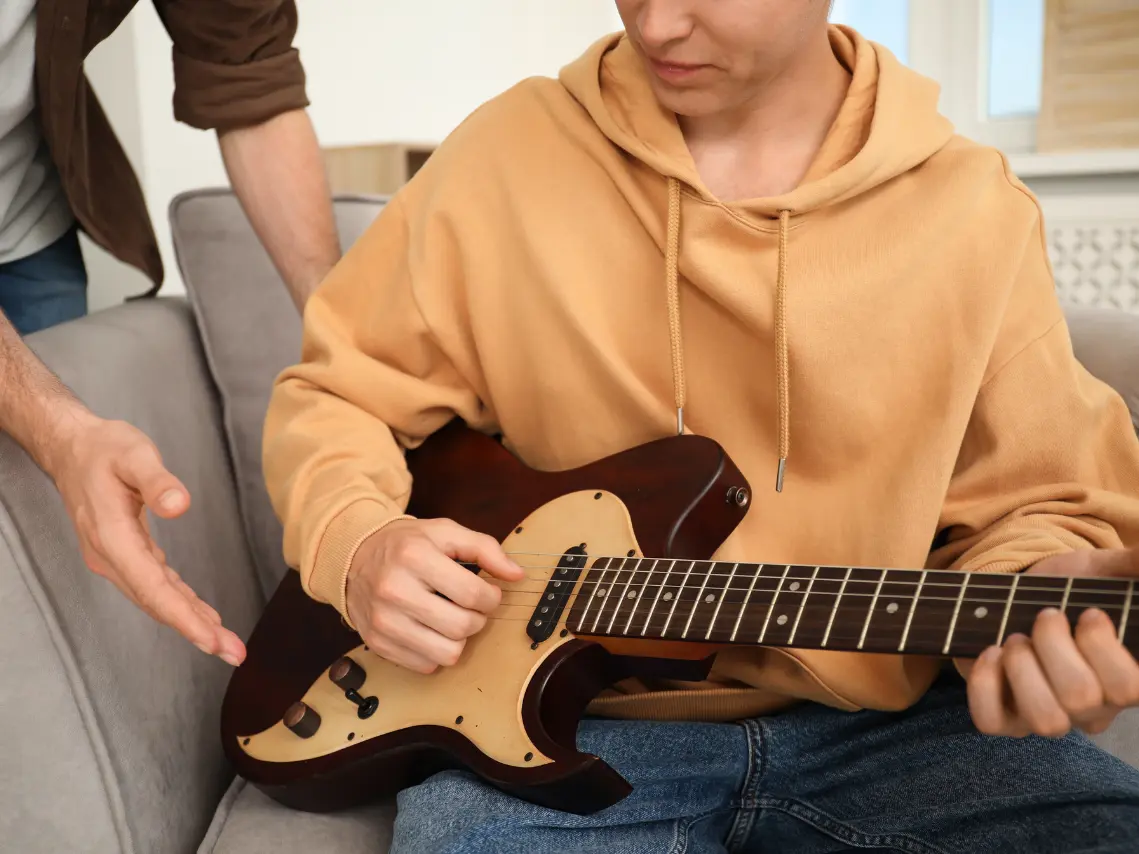
Most players can’t hear their own mistakes while actively playing — there is simply too much happening at once. Recording yourself during practice, even with a phone, gives you an outside view of your playing that reveals issues you would otherwise miss entirely. A qualified guitar teacher in Las Vegas, NV provides the same honest, real-time feedback with the added benefit of targeted corrections that recordings alone cannot offer.
Addressing Bad Habits Before Building New Skills
Practicing bad technique consistently doesn’t make it better — it makes it permanent. If you’ve developed tension in your picking hand, a sloppy chord transition, or a tendency to rush the beat, those habits need to be identified and corrected before you build new skills on top of them. This is one of the clearest reasons why working with a skilled instructor at Learn The Arts Las Vegas produces faster results than self-teaching alone.
How to Practice Guitar More Effectively Starting Today
Most players don’t need to practice more — they need to practice differently.
The Power of Slow and Deliberate Practice
Playing a difficult passage slowly and cleanly builds the muscle memory and accuracy that fast, sloppy repetition never does. Speed is the reward for accuracy — it comes naturally once your fingers know exactly what they are supposed to do. If you can’t play something slowly and clearly, you’re not ready to play it fast, and pushing the tempo before accuracy is established only reinforces mistakes.
Using a Metronome to Build Real Timing
A metronome is one of the most important and most ignored practice tools available to guitarists at every level. Playing with a consistent beat trains your internal sense of rhythm in a way that free-form practice simply cannot. Start with the tempo low enough that every note and chord change is clean, then move it up in small increments as your accuracy improves.
Chunking Difficult Passages Into Small Sections
Instead of running a whole song from start to finish and glossing over the hard parts, isolate the specific two or four bars that are giving you trouble and work on those alone until they are solid. This targeted approach solves problems directly rather than playing around them. Most guitarists who feel stuck are actually stuck on the same two passages in every song — chunking finds and fixes those spots fast.
Recording Yourself to Hear What You Miss While Playing
Short practice recordings — even informal ones taken with a phone — reveal timing issues, missed notes, and tonal inconsistencies that are difficult to catch while actively playing. Listening back even once a week creates a powerful feedback loop that speeds up self-awareness and deliberate improvement. Many Las Vegas guitarists who start recording their practice are surprised by both what needs work and how quickly things improve once they can hear it clearly.
Chord Mastery — Getting Cleaner and Faster at the Same Time
Chord playing is where most beginners and intermediate players have the most room for quick, visible improvement.
The Most Effective Chord Transition Exercise
Set a timer for sixty seconds and count how many clean transitions you can make between two specific chords. Practice this daily and track your numbers — most players see a significant jump within two weeks of consistent targeted work. The key is keeping every transition clean and in time rather than rushing through sloppy changes to hit a higher count.
Mastering Barre Chords Once and for All
Barre chords are the wall that stops many intermediate players from moving forward, and the fix is almost always about wrist position and finger placement rather than finger strength. Place your index finger as close to the fret as possible, roll it slightly toward the nut, and make sure your thumb is centered behind the neck rather than gripping over the top. Consistent daily work on this specific adjustment — not just general playing — resolves most barre chord problems within a few weeks.
Improving Your Strumming and Rhythm Playing
Rhythm is what separates guitarists who sound musical from those who simply play the right notes.
Developing a Stronger Internal Sense of Rhythm
The best rhythm players have a deep internal pulse that stays steady regardless of what their hands are doing on the strings. Practice strumming simple patterns with a metronome while focusing entirely on locking your strumming arm’s motion to the beat rather than thinking about which strings to hit. This arm-first approach to rhythm development produces a more natural, groove-based feel than chord-first thinking.
Muting Techniques That Transform Your Sound
Palm muting and left-hand muting are two of the most underused tools in a rhythm guitarist’s kit, and mastering them immediately makes your playing sound more controlled, dynamic, and professional. Muting gives you the ability to create contrast between open and dampened sounds within a single strumming pattern, adding texture that makes even simple chord progressions come alive in a way that pure strumming cannot.
Developing Your Lead Guitar Skills
Lead playing opens up a completely new dimension of the instrument — and it’s more accessible than most rhythm-focused players think.
Starting With the Pentatonic Scale
The minor pentatonic scale is the foundation of most rock, blues, and pop soloing, and learning it in one position gives you immediate access to usable phrases over a huge range of music. Start by learning the first position shape, practice it slowly up and down with a metronome, then begin connecting individual notes into short musical phrases rather than just running the scale mechanically. The goal is to make the scale sound like music, not an exercise.
Adding Bends, Slides, and Vibrato
Bends, slides, and vibrato are what give lead guitar its expressive, vocal quality — the techniques that make a single note sound like it’s saying something. These are best learned slowly and deliberately, with particular attention to pitch accuracy on bends, which should land squarely on the target note rather than falling short. Even one well-executed bend with confident vibrato makes a solo phrase sound dramatically more musical and intentional.
Learning Songs as a Strategy for Getting Better
Learning complete songs is one of the most enjoyable and effective ways to develop real guitar skills in a musical context.
Choosing songs that are just slightly above your current comfort level — rather than far beyond it or comfortably below it — creates the ideal conditions for growth. Every new song introduces a new chord shape, rhythm pattern, or technique that builds your overall vocabulary as a player. Building a small personal repertoire of songs you can play confidently from start to finish is also one of the best ways to stay motivated and measure real progress over time.
Staying Motivated While Working Toward Getting Better
Setting Specific and Measurable Goals
Vague goals like “get better at guitar” produce vague results. Specific goals like “cleanly play an F barre chord by the end of the month” or “learn the full chord progression to one new song this week” create a clear target that practice can be organized around. Reviewing and updating your goals regularly keeps the learning process feeling forward-moving and purposeful rather than open-ended and discouraging.
Tracking Progress With Videos
Short monthly practice videos give you a concrete record of how far you’ve come — which is often much further than daily practice feels from the inside. Looking back at where you were three or six months ago is one of the most reliable and motivating reality checks available to any guitarist working to improve. Many students at Learn The Arts Las Vegas use this simple strategy to stay energized through the inevitable slower stretches of their learning journey.

Where to Find Expert Guitar Instruction in Las Vegas, NV
For guitarists in Las Vegas, NV who are ready to move past self-teaching and make real, consistent progress, Learn The Arts Las Vegas is an outstanding destination. With experienced instructors across multiple styles and skill levels, a personalized and practical curriculum, professional studio facilities, and a warm and encouraging community for students of every background, Learn The Arts Las Vegas provides the kind of guitar instruction that produces fast, visible, and lasting results. Contact us today to schedule your first lesson and start getting better right away.
Wrapping Up
Getting better at guitar comes down to three things — practicing with intention, fixing what is already holding you back, and staying consistent over time. Natural talent matters far less than most players think. What matters most is showing up, working smart, and getting the right guidance at the right time.
Whether you’re working through your first chord or pushing through an intermediate plateau, Learn The Arts Las Vegas in Las Vegas, NV is ready to meet you exactly where you are and help you move forward faster than you could on your own. Reach out today and take the next step toward the guitarist you know you can become.
FAQs
Do guitar programs in Las Vegas, NV include instruction for players who feel stuck at their current level?
Yes, Learn The Arts Las Vegas works with guitarists at every stage — including intermediate players who have hit a plateau and need targeted guidance to break through. Instructors identify the specific habits and gaps holding each student back and design a practical plan to address them directly. Most students notice real improvement within the first few weeks of focused, guided practice.
Do guitar programs in Las Vegas, NV include help with technique and bad habits?
Yes, one of the first things experienced instructors at Learn The Arts Las Vegas address is technique — including hand position, posture, tension, and any bad habits that have developed through self-teaching. Correcting these fundamentals early prevents them from becoming permanent limitations and frees up the student to progress much faster. Real-time feedback from a qualified teacher is the most effective way to identify and fix technique issues that recordings alone may not fully reveal.
Do guitar programs in Las Vegas, NV include instruction across different styles and genres?
Yes, Learn The Arts Las Vegas offers guitar instruction across rock, blues, classical, folk, jazz, pop, and fingerstyle — allowing students to pursue the genre that genuinely excites them most. Instructors build curriculum around your musical interests, ensuring that what you practice in lessons stays connected to the music you actually want to play. Exploring multiple styles also develops technical versatility that benefits your playing across every genre.
Do guitar programs in Las Vegas, NV include flexible scheduling for students with busy lives?
Yes, Learn The Arts Las Vegas offers evening and weekend scheduling options designed to fit the routines of working adults, students, and families across Las Vegas, NV. Our staff works with every student to find lesson times that make consistent weekly attendance as simple and sustainable as possible. Regular weekly lessons combined with focused daily practice between sessions are the most reliable combination for fast and steady guitar improvement.
Do guitar programs in Las Vegas, NV include performance opportunities for students?
Yes, Learn The Arts Las Vegas hosts regular showcases and studio events that give guitar students meaningful opportunities to perform and celebrate their progress throughout the year. These events build stage confidence, musical maturity, and a genuine sense of personal achievement that keeps students motivated and committed to their instrument. Performing even once in a supportive, low-stakes setting is one of the most growth-accelerating experiences any guitarist can have.