


Introduction
The single biggest factor that determines how quickly an adult beginner progresses at piano is not the quality of their teacher, the price of their instrument, or even their natural musical ability — it’s what happens at home between lessons. A student who takes one lesson per week and practices thoughtfully and consistently for just 20 minutes a day will make more progress in three months than a student who takes twice as many lessons but barely touches the keys between sessions. The problem is that most adult beginners have never been taught how to practice effectively — and without that knowledge, home practice sessions turn into aimless noodling that burns time without building real skills. This guide gives adult beginners a complete framework for making every home practice session count — covering how much to practice, how to structure each session, what to focus on, and how to build a habit that survives the inevitable chaos of busy adult life.
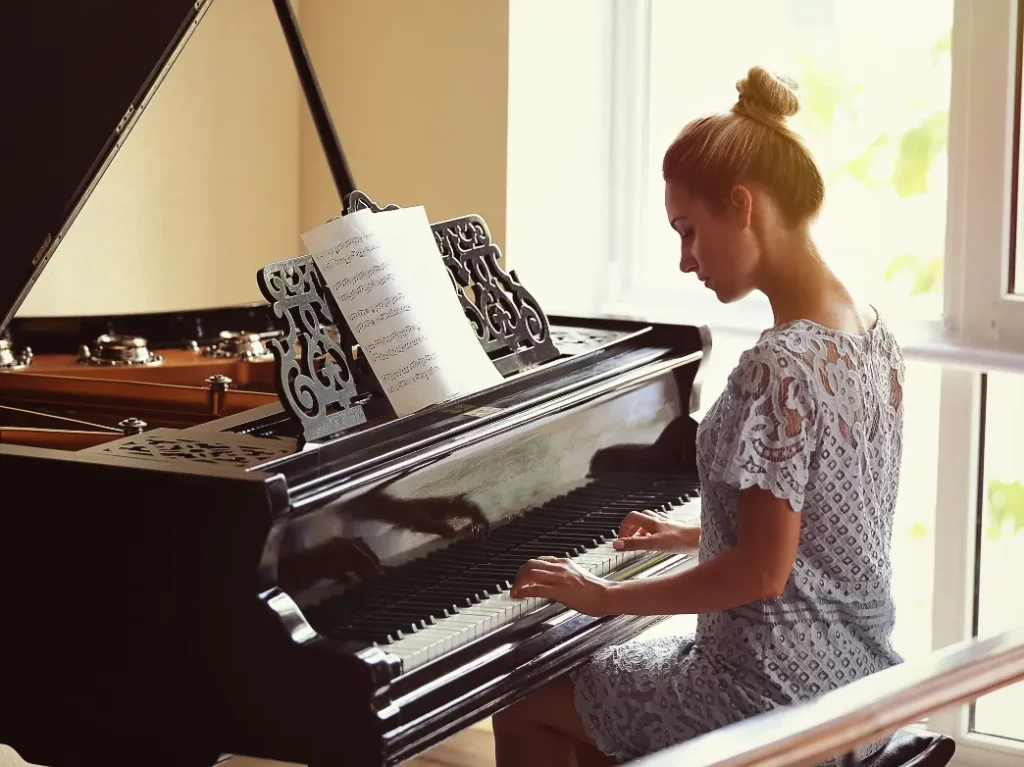
How Much Should Adult Beginners Practice Each Day?
Why 20 Minutes Done Daily Beats Two Hours Done Once a Week
Piano is a motor skill as much as an intellectual one — and motor skills are built through repetition spaced out over time, not crammed into a single long session. Twenty minutes of focused daily practice builds muscle memory, finger coordination, and note recognition far more effectively than a two-hour session once a week. Consistency is the ingredient that no amount of talent or lesson quality can replace.
What to Do When Life Makes Even 10 Minutes Feel Impossible
On the days when 20 minutes genuinely isn’t available, 10 minutes still counts. Even a short session reviewing one passage or drilling one chord change keeps the habit alive and prevents skill from sliding backward. Adult learners who give themselves permission to do less on hard days practice far more consistently over the long run than those who treat anything less than a full session as a failure.
How to Structure a 20-Minute Practice Session
Not all 20 minutes should go toward the same thing. A productive practice session moves through distinct phases — a brief warm-up with finger exercises to loosen up and get your hands ready (roughly the first three minutes), then technical work on scales, chords, or specific techniques your teacher has assigned (the next six or seven minutes), then focused song practice on your current repertoire piece (the following seven or eight minutes), and finally a couple of minutes of free exploration where you play whatever feels good without a specific goal.
That last phase is not wasted time. It keeps practice from feeling like pure obligation and preserves the enjoyment that made you want to play in the first place — which is what keeps adult learners coming back day after day.
The Deliberate Practice Method for Adult Piano Learners
Why Playing Through Songs Without Stopping Is Not Real Practice
Running through a piece from start to finish without stopping feels productive, but it mostly just reinforces what you already know. The difficult spots — the chord transition that always fumbles, the rhythm that never quite lands — get glossed over every time. Real improvement comes from isolating exactly those spots and working on them directly until they’re solid.
How to Isolate and Fix the Sections That Trip You Up
Take the two or four bars that give you the most trouble and practice only those until they’re clean and consistent. Once that section works reliably at a slow tempo, move it up gradually and reconnect it to the surrounding measures. Most adult beginners who feel stuck are stuck on the same two spots in every piece — targeted drilling finds and fixes those spots fast.
Slow Practice — The Key to Playing Faster
Why Practicing Slowly Produces Faster Results
Practicing too fast before a passage is clean builds sloppy habits that become harder to undo the longer they sit. Slow practice trains your fingers to land in exactly the right place every time, building the accuracy that speed follows naturally. If you can’t play something cleanly and slowly, you’re not ready to play it fast — pushing the tempo before accuracy is established only reinforces the mistakes you’re trying to fix.
How to Know When You’re Ready to Increase Tempo
A good rule of thumb: if you can play a passage correctly ten times in a row at a given tempo with no errors, you’re ready to move it up a notch. Use a metronome and increase in small increments rather than jumping straight to the speed you want. This gradual approach feels slower in the short run but produces far more reliable results than pushing tempo before you’ve truly earned it.
Building a Piano Practice Habit That Actually Sticks
The Habit Stacking Method for Adult Learners
Willpower alone is not a reliable practice strategy for adults with full lives and unpredictable schedules. Habit stacking — attaching your practice session to something you already do every day, like your morning coffee or the few minutes after dinner — turns practice from a daily decision into an automatic behavior. The less you have to decide whether to practice on any given day, the more consistently you actually do it.
What to Do When You Fall Off the Practice Routine
Every adult learner falls off at some point — a busy week, a vacation, a stretch where life takes over. The important thing is not avoiding those gaps but knowing how to respond when they happen. Come back without guilt, start with something easy and enjoyable to rebuild momentum, and resist the urge to make up for lost time with a marathon session. Returning consistently after a break matters far more than the break itself.
Common Home Practice Mistakes Adult Beginners Make
A few habits show up consistently in adult beginners who feel like they’re not making real progress:
- Always starting from the beginning. The opening of every piece gets plenty of practice while the hard middle section stays weak. Start with your problem spots instead.
- Practicing at full speed before mastering it slowly. Speed is the reward for accuracy — not the starting point.
- Skipping days and compensating with long sessions. Marathon sessions don’t replace daily contact with the keys.
- Playing only what’s comfortable. Growth lives just beyond your current ability — not in the songs you already know well.
- Ignoring posture and hand position. Bad habits formed at home undo the technique work done in lessons and create tension that limits progress over time.
How to Know Whether Your Practice Is Actually Working
Signs That Your Sessions Are Productive
Productive practice feels focused and slightly challenging — not easy and not overwhelming. You should be able to hear specific, measurable improvement on the passages you’ve been drilling: cleaner transitions, steadier rhythm, better tone. If your playing on a particular section sounds noticeably better at the end of a week than it did at the start, your approach is working.
Measuring Progress Through Monthly Self-Recordings
Recording yourself playing once a month — even informally on a phone — gives you a concrete way to hear how far you’ve come. Progress in the early stages of piano can feel invisible from the inside because you’re always focused on what still needs work. Listening back to a recording from two or three months ago often reveals improvement that daily practice made impossible to notice in real time.
Where to Find Piano Lessons for Adult Beginners Near Gilbert, AZ
For adult beginners in Gilbert, AZ looking for piano lessons nearby, Gilbert School of Music is a trusted and welcoming destination. With patient and experienced instructors who specialize in working with adults, flexible scheduling built around busy lives, and a warm and encouraging environment for students at every starting point, Gilbert School of Music gives adult beginners exactly the support they need to build real skills and stay motivated for the long run. Contact us today to get started.
Wrapping Up
What happens at home between lessons is the real engine of your progress as an adult piano student. The right practice approach — focused, consistent, and built around honest repetition — makes a bigger difference than almost anything else in how quickly you improve.
Gilbert School of Music in Gilbert, AZ is here to give you both the in-lesson guidance and the practical practice tools you need to make every minute at the keys count. Reach out today and take the next step in your piano journey.
FAQs
Do piano programs for adult beginners in Gilbert, AZ include guidance on how to practice effectively at home?
Yes, Gilbert School of Music instructors actively teach adult beginners how to practice between lessons — not just what to practice. Students leave each session with a clear plan covering specific passages to drill, techniques to focus on, and a realistic time framework for their schedule. This kind of structured guidance is one of the most valuable things a beginner gains from working with a qualified teacher.
Do piano programs for adult beginners in Gilbert, AZ include flexible scheduling options for busy adults?
Yes, Gilbert School of Music offers lesson times designed to fit the routines of working adults and families across Gilbert, AZ. Evening and weekend appointments are available, and the team works with each student to find a consistent weekly time that makes showing up as simple as possible. Regular weekly lessons combined with focused daily home practice between sessions produce the most consistent and lasting results.
Do piano programs for adult beginners in Gilbert, AZ include instruction for people starting with no prior musical experience?
Yes, Gilbert School of Music welcomes adult beginners with no prior experience and no background in reading music. Instructors build a solid foundation from the ground up — covering posture, hand position, basic music theory, and beginner repertoire at a pace that fits each student’s learning style. Many adult beginners are genuinely surprised by how quickly real, playable skills develop with the right guidance in place.
Do piano programs for adult beginners in Gilbert, AZ include feedback on technique and hand position?
Yes, instructors at Gilbert School of Music address technique, posture, and hand position from the very first lesson — because these fundamentals directly affect how fast a student progresses and how comfortable practice feels over time. Catching and correcting technique issues early prevents them from becoming habits that limit long-term progress. This kind of real-time correction is one of the clearest advantages of in-person lessons over self-teaching.
Do piano programs for adult beginners in Gilbert, AZ include performance opportunities for students who want them?
Yes, Gilbert School of Music hosts regular recitals and showcases that give adult students meaningful opportunities to perform in a supportive and encouraging setting — for those who want them. These events are never mandatory, but many adult students find that having a performance to prepare for gives their practice a clear and motivating purpose. For most, the experience of performing successfully even once becomes one of the most rewarding milestones in their entire learning journey.